

Integrating an AI function into a PHP application does not mean that all available information needs to leave the application. A summary, classification, or contextual response often requires only some of the data the system holds about a person or process. The decision should be based on the specific task and verified against the actual data flow, not just the interface that invokes the model.
Data minimization in PHP AI integrations means sending only the information needed for a defined purpose, for as long as and through the channels that purpose requires. It does not, by itself, eliminate privacy risks: logs, errors, responses, permissions, and external dependencies must also be controlled.
Trace the data flow before changing the code
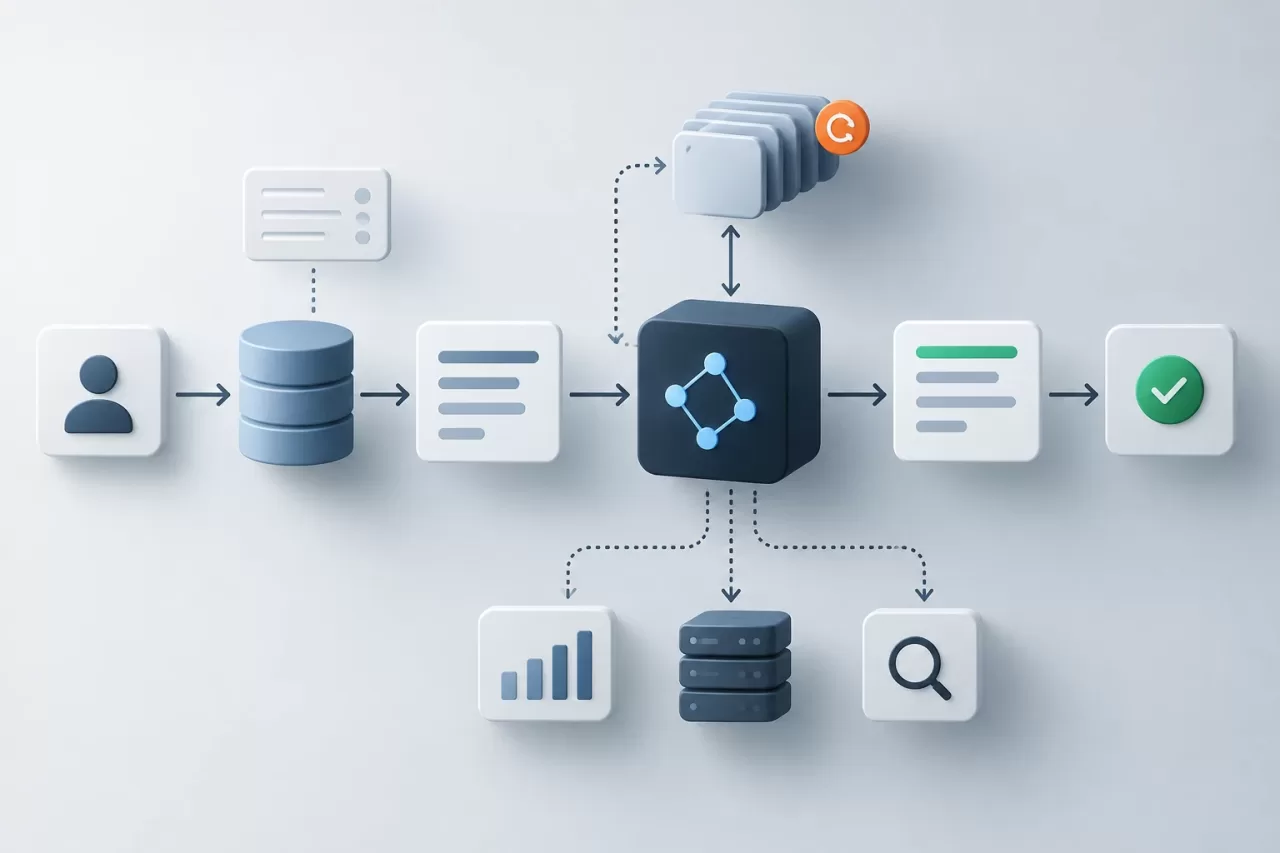
Document what data enters the function and what happens next. A typical flow includes user input, context retrieved from the database, message preparation, a request to the AI provider or service, the response, and internal logs. Also check whether queues, retries, observability, or support tools copy the content.
For each stage, identify the owner, destination, purpose, and retention period. In PHP, locate both the code that builds the request and the points where exceptions are logged and results are persisted. Reviewing only the HTTP call can miss copies in traces, debugging output, or asynchronous jobs.
- Which fields are queried, and which ones actually end up in the request?
- Does the request include context from previous conversations or attachments?
- What is logged if the connection fails, times out, or returns an invalid response?
- Is the full response stored when it would be enough to save the required result?
Define an allowlist for each use case
Classify fields according to whether the task needs them, not according to how easy they are to retrieve. A useful classification separates essential data, data that helps only in specific cases, and data that must not be sent. For example, a function that categorizes a message might need its text and a limited list of categories, but not necessarily the sender’s name, email address, mailing address, or full history.
Turn that decision into an allowlist specific to each function. Avoid serializing an entire entity or passing a domain object directly to the AI layer: such objects may contain sensitive fields today or acquire them later. Build an explicit data transfer object with the approved values and validate its structure before creating the request.
$input = [
    'message' => $ticket->publicMessage(),
    'allowed_categories' => $categoryNames,
];

$payload = $validator->validate($input);
Validation should enforce size and format limits, as well as check that no fields outside the allowlist are present. Keep authorization to read information in the application separate from the decision to include it in the request: the fact that a PHP process can access some data does not mean the AI function needs it.
Reduce identifiers without relying on pseudonymization alone
When a task needs to distinguish records but does not need to know a person’s real identity, it may be feasible to replace direct identifiers with internal references or pseudonyms. Keep the table mapping the reference to the person inside the application and out of the content being sent, with access restricted. Do not send keys that could be used to reconstruct an identity unless they are essential.
Pseudonymization is not the same as anonymization. Free text can reveal someone’s identity through names, job titles, locations, dates, incident details, or a combination of attributes. It may also be possible to re-identify someone by matching the data with other information. Review the content and context, not just structured fields; where appropriate, redact or generalize details before sending them.
If removing a piece of data affects response quality, try less identifying alternatives: ranges instead of exact values, categories instead of personal descriptions, or a summary prepared by the application. Keep the information needed to link the response to the correct record in PHP, unless the task requires otherwise.
Keep information the model does not need under PHP’s control
Separate context preparation from business logic. PHP can enforce permissions, resolve relationships, select fields, and combine AI output with data that was never sent. The function can return a label or suggestion; the application remains responsible for checking that the result is valid and deciding whether to take an action.
Set limits for responses: expected format, length, allowed values, and how to handle unexpected content. If output is shown to users, escape it according to the presentation context and do not treat it as a trusted instruction. If it could trigger an operation—for example, modifying a record—require additional validation and, depending on the impact, human confirmation.
Failures are also part of the design. Define what to do in the event of a timeout, provider error, empty response, or uninterpretable format. Depending on the case, an alternative might be to ask the user to try again, offer a manual process, or continue without the function. Avoid unlimited retries, and do not return internal details containing requests, credentials, or personal data to the user.
Prevent logs from becoming a second copy
Log useful operational signals—correlation ID, duration, status, and error code—without automatically saving the full prompt and response. If content needs to be retained to investigate a problem, define its purpose, access, and retention period, and consider a redacted view or a test environment with synthetic data.
Review exception messages, monitoring tools, queues, and audit logs. An error should not reproduce the full request by default. The same principle applies to temporary debugging: restrict when it can be enabled, avoid real data where possible, and verify that it is not left enabled in production.
Test usefulness and limitations with representative cases
Before enabling the flow, create cases representing typical inputs, edge cases, and failures, without using real personal information unless there is a justification and appropriate safeguards. Compare the function using the planned set of fields with a reduced version. Assess whether it performs the task, whether it fabricates information or misclassifies, and whether an incorrect response could cause harm.
Add automated tests to check that excluded fields do not appear in the payload, large inputs are limited, redacted data does not reach logs, and responses in an unexpected format are rejected or handled safely. Repeat these checks when the data schema, prompt, provider, or preparation logic changes.
Checklist before enabling the function

- The purpose is defined, and every field sent has a specific justification.
- The payload is built from an allowlist, not from an entire entity.
- Identifiers and free text are reviewed for re-identification risks.
- The application retains control of permissions, business rules, and data the AI does not need.
- Requests, responses, and errors are not copied to logs or traces without controls.
- Input limits, output validation, and a fallback for failures are in place.
- Tests check both usefulness and the absence of excluded fields.
- The team knows which changes to the flow require the assessment to be reviewed again.
The right decision is neither to send as much context as possible nor to remove data blindly. It is to justify every field in relation to the task, keep control in PHP, and test that reducing the data preserves acceptable usefulness without unnecessarily increasing exposure.