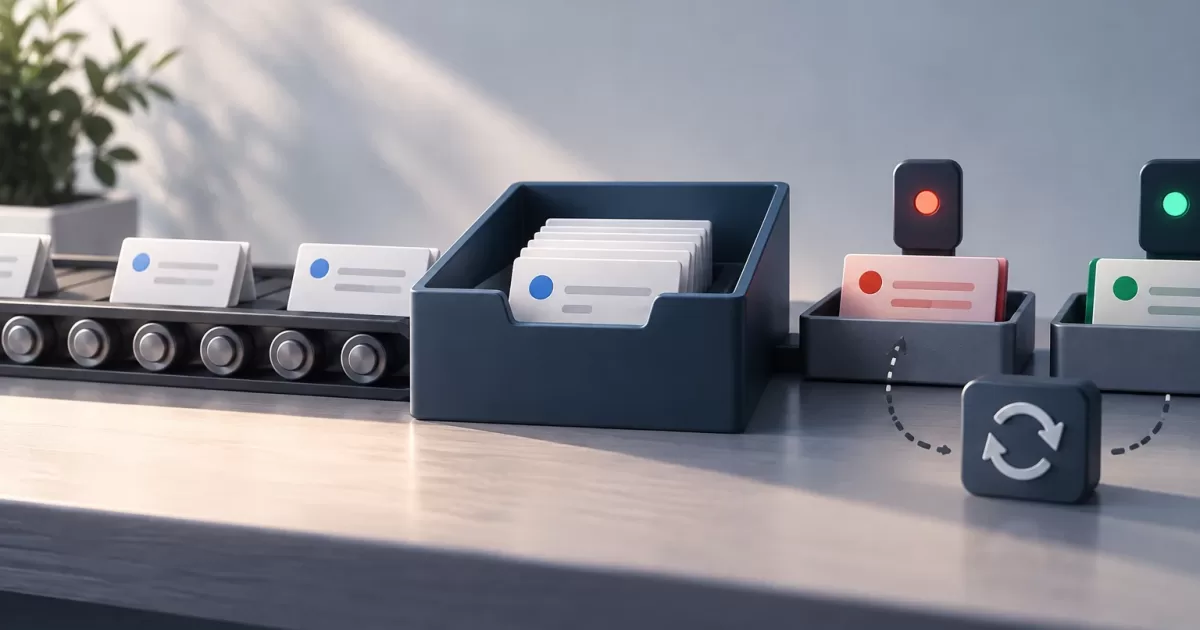

How to Design a Review State for Uncertain Data in a PHP Application
Design traceable human review in PHP: separate received data from decisions, define transitions, and control permissions, concurrency, and corrections.
Read articleClear guides on SaaS products, architecture, automation, data, AI, quality, DevOps, commerce and PHP teams, written from a delivery perspective.

A featured read to better understand a common decision in PHP projects.
Design traceable human review in PHP: separate received data from decisions, define transitions, and control permissions, concurrency, and corrections.
Read articlePractical content organized for easy reading and quick access to the topic you need.
Define states, revoke access, control queues and integrations, and verify every step so a SaaS organization can be deactivated safely and resumed if needed.
Evaluate a PHP framework migration with a limited-scope pilot: choose a representative workflow, set criteria, compare results, and make an evidence-based decision.
The transactional outbox pattern in PHP prevents events from being lost between a business transaction and a queue. Learn how to process, retry, and monitor them.
Learn how to choose transaction boundaries, record checkpoints, and resume PHP imports without duplicating changes or hiding partial failures.
Learn to distinguish a pattern from an isolated case and document rules, exceptions, and acceptance criteria before changing a PHP application.
Record incoming events, investigate failures, and enable controlled retries in PHP without confusing an inbox with a queue or an audit log.
Define filters, permissions, queries, and tests so your team can find records in PHP without exposing data beyond its authorized scope.
A practical guide to spotting hard-to-reverse commitments, limiting their impact, and defining signals that indicate when to revisit a technical decision.
A PHP project handover to an internal team must show that its new owners can operate, diagnose, and evolve the system—not just access the code.
Prepare a PHP application for traffic spikes with realistic scenarios, useful metrics, and an intervention sequence that protects critical functions.
Design a fallback for AI integration in PHP with timeouts, bounded retries, safe alternatives, and useful logs that do not expose sensitive data.
Find out whether your PHP application can truly recover: define objectives, restore in isolation, validate data and dependencies, and turn every failure into an action.
Learn how to record who changed what, when, and in what context in a PHP application, protect the history, and verify its integrity without duplicating the entire database.
Design a data deletion workflow in PHP with clear scope, resumable execution, and system-by-system checks—without confusing a logical deletion with an effective one.
Design PHP exports that scale without blocking the application: authorization, chunked processing, protected downloads, expiration, and recovery.
A data migration cannot always be undone by restoring a backup. Learn how to choose between resuming, compensating, or restoring with verifiable controls.
Learn when a canary deployment in PHP makes sense, what infrastructure and metrics you need, and how to pause or roll back without putting all users at risk.
Learn how to pause sensitive operations, separate proposals from authorization, handle changes and retries, and keep an auditable record of every decision.
Design PHP imports that isolate invalid or questionable rows, let you correct and safely retry them, and maintain an auditable history.
Assign external PHP work without creating hidden dependencies: classify tasks, define interfaces, agree on how to handle blockers, and review autonomy from the first deliverables.
Set limits by identity, operation, and time; distinguish quotas from concurrency, and measure rejections before adjusting the policy.
Learn how to distinguish roles, capabilities, and store-specific rules to define access in WooCommerce, test it, and reduce operational errors.
Compare Laravel, Symfony, CodeIgniter, and Laminas based on your team, integrations, and operations—and find out when to keep your existing framework.
We explain when each topic matters and which risk it addresses.
We compare alternatives and make their trade-offs visible.
We connect theory with real PHP systems.
Tell us about the context, the main blocker and the outcome you need. We will reply with the questions required for an initial assessment.