

A successful backup does not, by itself, prove that an application can resume service. A key, an external dependency, files that accompany the database, or a procedure specifying the order of recovery may be missing. Disaster recovery tests for PHP applications let you verify the entire process before data loss or corruption forces you to carry it out under pressure.
The goal is not to guarantee that outages will never happen, but to gather evidence about what can be recovered, how long it takes, and what obstacles remain. For the exercise to be useful, define its scope, isolate the environment, validate both the infrastructure and the application's behavior, and assign owners to the necessary improvements.
Verifying a backup is not the same as restoring service
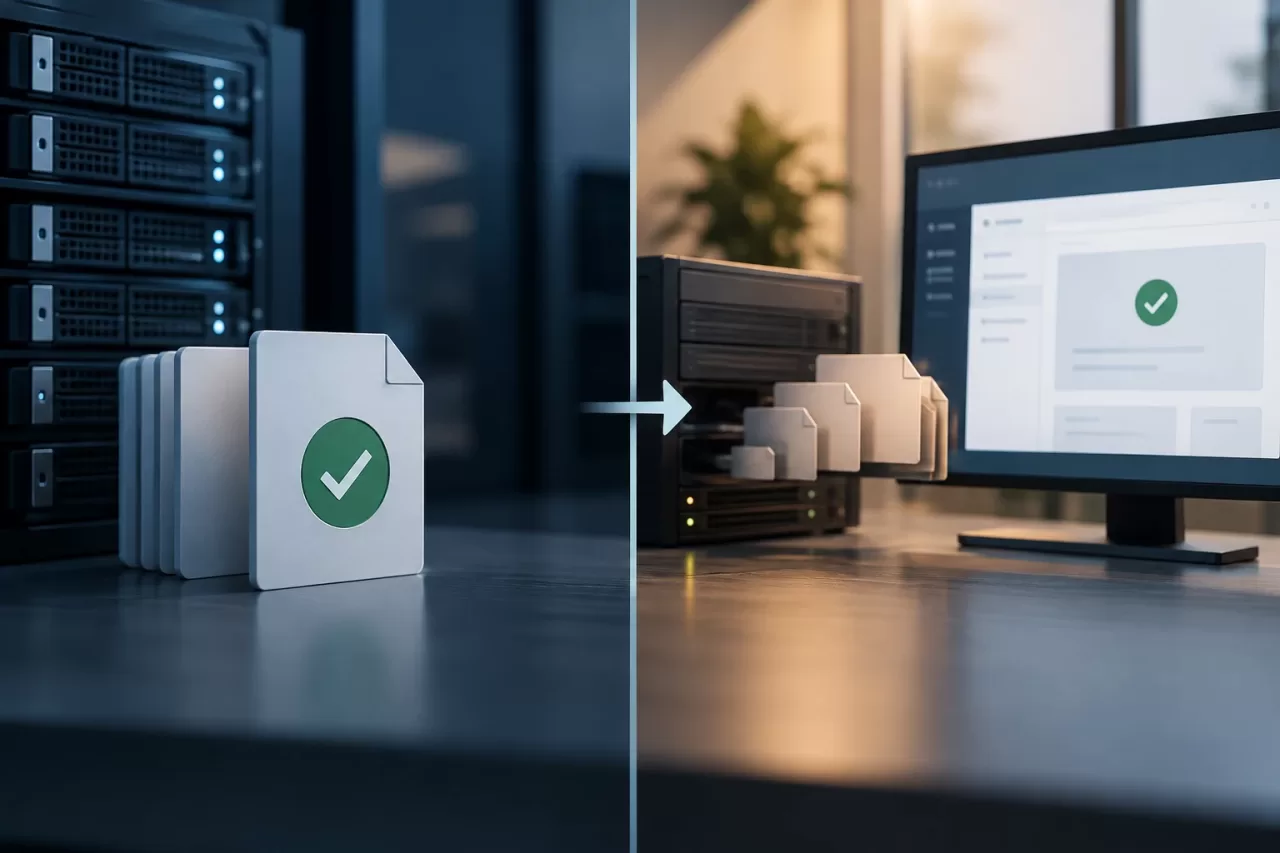
A backup check can confirm that a file exists, that its size seems reasonable, or that a tool can read it. This is a valuable control, but it is different from restoring the required components and demonstrating that the application works with them.
Full recovery may include a database, user-uploaded files, code and configuration, as well as services such as job queues, object storage, cache, or scheduled tasks. It may also depend on DNS, certificates, permissions, PHP extensions, and external services. If one of these elements is missing or does not match the others, the backup may be valid and yet the service may not be recovered.
Define what “recovered” means for each application. It might mean that the PHP process starts, that authorized users can sign in and complete a critical workflow, or that background jobs resume processing. A visible home page is not sufficient as the sole criterion.
Define scope and success criteria before you start
Document the scenario to be tested: for example, loss of a database, file corruption, or an entire environment becoming unavailable. You do not need to simulate every incident in a single session. Defining the scenario makes it possible to identify which components must be restored and what is explicitly outside the exercise's scope.
Agree on verifiable criteria with the business, technology, and operations teams. Practical questions include:
- Which functions must become available again, and which can wait?
- How far back would it be acceptable to recover the data, and what loss of changes would be tolerable?
- How long can the service be interrupted before the impact becomes unacceptable?
- Which dependencies are part of the recovery, and which will be represented by safe substitutes?
- Who authorizes the execution, validates the result, and communicates issues?
Recovery point objectives (RPOs) and recovery time objectives (RTOs) can help express tolerances for data loss and service interruption. They should be agreed according to each service's needs and capabilities; there is no universal value. The test lets you compare observed recovery times and data state with those objectives, without treating a single result as a guarantee of future outcomes.
Prepare an isolated and secure environment
Perform the restoration in an environment separate from production, with controls to prevent the exercise from altering real data or sending messages to customers. Isolate networks where possible, and block or replace integrations that could process charges, send emails, publish events, or modify external systems. Tell participants that this is a test.
Restored data may contain sensitive information. Apply the relevant access, retention, and data protection policies; limit who can access the environment and for how long. Avoid reusing production credentials. Manage test secrets in a controlled manner, and verify that restored files do not expose them in logs, repositories, or publicly accessible directories.
Record the initial conditions: the backup date and recovery point, required code and configuration versions, available resources, and differences between the test and production environments. A different PHP version, missing extensions, or different permissions can affect the outcome. Record these discrepancies rather than mistaking them for a backup success or failure.
Recover all required components
Follow the documented procedure, even if you know a faster way. The point is to check whether the instructions are sufficient for someone else to recover the service. Record the order and duration of each step, manual commands, decisions made, and any unplanned intervention.
One possible sequence, which must be adapted to each architecture, is to restore the infrastructure and configuration, recover the database and files, deploy a compatible code version, and connect the required dependencies. In PHP, review the web server and PHP-FPM configuration, required extensions, environment variables, write permissions, and scheduled tasks, as applicable. Also check queues, object storage, and worker processes if the application depends on them.
Do not run migrations or data-rebuilding processes automatically without understanding their effect on a restored backup. Verify that credentials point exclusively to test services and that cron jobs do not produce external side effects. If recovery requires manual intervention, record it as part of the actual recovery time and as a potential improvement area.
Validate integrity and behavior, not just startup
Checks should cover both data and functional workflows. Start with technical checks: database connectivity, process status, available disk space, error logs, and responses from internal services. Then validate that stored files and references match, and that important database relationships or constraints remain consistent.
Choose representative queries and workflows that reflect the application's actual use. For example, check that you can find a known entity, sign in with a test account, and complete an operation with no external side effects. If users upload files, verify that they can be retrieved and matched to their records. If queues exist, check that pending jobs behave as expected and are not accidentally processed twice.
Keep enough evidence to repeat the assessment: query results, steps performed, errors observed, and start and end times. A note saying “it works” is not enough. Define in advance which checks constitute a pass and which are blocking. An application that responds but displays incomplete data or cannot process critical operations should not be considered recovered under stricter criteria.
Measure, fix, and repeat at a useful cadence

Measure the time from the agreed start until the recovery criteria are met, not just the time it takes to restore a database. If it helps the analysis, separate waiting time, automated work, manual steps, and validation. Compare the result with the agreed objectives and identify unmet assumptions, such as unavailable permissions or outdated documentation.
The report should include the scope, recovery point, result of each check, observed times, incidents, decisions, and owners of corrective actions. Prioritize measures that remove blockers: automate repeatable steps, update instructions, fix permissions, review dependencies, or improve the backup strategy. Assign follow-up dates and repeat the affected part to check whether the fix resolved the problem.
The cadence depends on risk, architectural changes, and operational capacity. It can combine frequent partial restorations—for example, of a database or files—with full recovery exercises and different scenarios. It is also advisable to repeat the test after significant changes to the backup system, infrastructure, or dependencies. A successful test provides evidence about a specific scenario and set of conditions; it does not guarantee the outcome of every future incident.