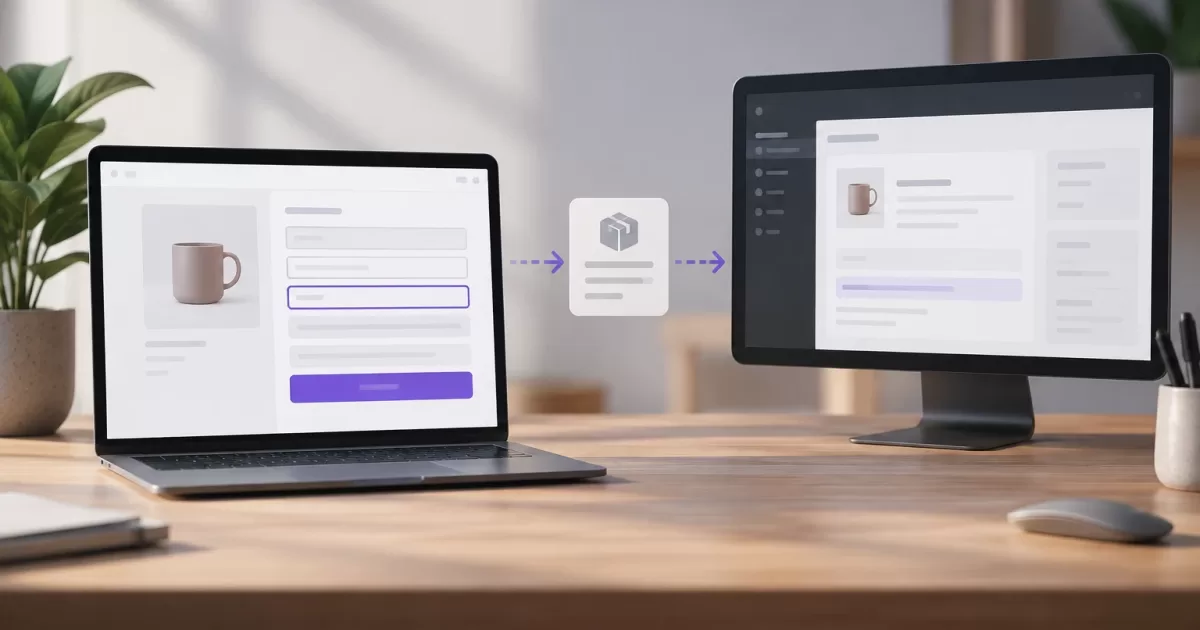

A business rule stops being a store configuration when it affects more than one decision, depends on external data, or must be explainable after it has run. For example: calculating a price based on ERP conditions, reserving stock across multiple warehouses, blocking a purchase due to operational risk, or sending an order to a logistics system with its own exceptions.
In these cases, solving it with several plugins, chained settings, and code snippets may work at first, but it increases reliance on implicit behaviors. The problem is not that a plugin is a bad choice; it is using one to support business logic that needs clear ownership, testing, observability, and failure recovery. Maintainable WooCommerce integrations separate commercial operations from the details of the web channel without turning every need into a standalone application.
The turning point: from store configuration to domain rule

A configuration is usually local, declarative, and easy to verify: applying a tax, enabling a payment method, or displaying a shipping method by zone. A domain rule expresses a business policy and may change even if the WooCommerce interface does not.
The distinction matters because a policy needs a source of truth, an owner, and defined behavior for edge cases. If a promotion depends on up-to-date margin, customer contracts, and availability committed in an external system, it is not merely a catalog discount. It is a commercial decision that WooCommerce must request, apply, and record.
Before choosing technology, describe the rule without mentioning plugins: what data it receives, what outcome it produces, what exceptions it allows, who can modify it, and what must happen if information is missing. If you cannot answer those questions, automating first usually amplifies ambiguity.
Signs that the plugin or snippet is no longer enough
- The same rule is implemented in several places: a plugin, theme code, an automation, and an internal system.
- The outcome depends on APIs, ERP, WMS, CRM, carriers, or payment services with possible latency and errors.
- Changing it requires editing untested code or modifying settings whose combined effect no one can anticipate.
- An order can end up between systems: charged in the store but not created in logistics, or sent twice after retries.
- Operations needs to know why a price was applied, an order was held, or a return was rejected.
- There are recurring manual tasks to correct stock, statuses, imports, or customer data.
- Volume turns screen-based synchronization, a poorly controlled cron job, or a remote query on every page load into a performance risk.
It is also a relevant sign when the plugin is correct as a product but does not expose the required extension points, logs, version control, or data model. Replacing it with another plugin with more options does not always eliminate the problem; it may move it to a more opaque layer.
Decision map: theme, custom plugin, integration, or separate application
Presentation rule in the theme
The theme is for changing presentation: messages, product templates, field layout, or purely visual elements. It should not decide final prices, stock, authorizations, or critical order transitions. The template displays information; the domain model decides which information is valid.
Standard plugin or custom plugin
A standard plugin is appropriate when the process matches its configuration and its maintenance fits the operational risk. A custom WordPress plugin is reasonable for bounded WooCommerce extensions: additional fields, local validations, simple checkout rules, or specific adapters. It should have version-controlled code, testing appropriate to the risk, and a clear separation between the WooCommerce hooks layer and business logic.
Avoid loading the theme with snippets that change orders or prices. The theme is updated for interface reasons, and its lifecycle should not govern operational processes.
External integration
An external integration is appropriate when the rule belongs mainly to another system or requires asynchronous event processing. It may be a service that translates orders into the ERP format, checks availability, or applies a centralized commercial policy. WooCommerce remains the sales channel, while the integration controls exchange, retries, and traceability.
This does not necessarily mean creating a microservice. It may be a small, well-bounded component. The decision depends on responsibility boundaries, not on an architectural preference.
Separate application
A separate application makes sense if the domain already exceeds the WooCommerce channel: complex inventory management, omnichannel orchestration, pricing rules shared by multiple channels, or internal processes with their own users and permissions. The additional cost includes operations, security, deployments, monitoring, and support. Do not choose it merely to escape complexity: it must absorb a stable and explicit responsibility.
Technical criteria that change the choice
The first criterion is data ownership. For each relevant data item, define which system can modify it and which one publishes the authoritative version. Physical stock may belong to the WMS; the cart and shopping experience to WooCommerce; invoicing to the ERP. Copying every field in both directions without defined authority creates conflicts that cannot be resolved consistently.
The second is rule complexity. A local condition differs from a policy with priorities, effective periods, contracts, segmentation, and exceptions. The more important it is to explain the decision, the more advisable it becomes to encapsulate it behind a clear interface and store the rule version or the data that originated it.
The third is behavior on failure. An external call during checkout may time out. Determine whether the purchase is blocked, continues with an estimate, remains pending review, or uses cached data with an acceptable maximum age. The answer must depend on the operation: displaying an estimated date does not carry the same risk as confirming a stock reservation.
For asynchronous exchanges, use stable identifiers, idempotent operations, and a queue or equivalent retry mechanism. If an order is resent, the receiver must recognize that it is the same event and not duplicate the shipment. Also record the requested transition, the response received, and the reason for the error, without exposing unnecessary personal data.
Orders, stock, prices, and returns without duplicating the truth
The order must retain a commercial snapshot: purchased line items, amounts, taxes, discounts, address, and selected method. A later price change in the ERP should not indiscriminately rewrite the amount of a confirmed order. In contrast, operational statuses can be synchronized through an explicit map between WooCommerce statuses and events in the responsible system.
For stock, distinguish between published availability, temporary reservation, and physical inventory. If there are multiple channels, publishing a figure from the inventory system is usually safer than allowing bidirectional adjustments without conflict rules. Also define what happens with cancellations, failed payments, and expired reservations.
Returns require special care: the customer request, physical receipt, acceptance decision, and refund are distinct events. A generic status change does not replace operational evidence or the return policy.
Minimum operations: tests, logs, and an incident console
Before automating a critical flow, prepare test cases for valid data, incomplete data, duplicates, out-of-order status changes, external unavailability, and retries. In PHP, test decision logic separately from WooCommerce adapters and HTTP calls. Integration tests must validate real contracts or controlled environments, not only mocked responses.
A minimum operational console does not have to be complex. It must allow you to locate an order or event, know its synchronization status, view the latest error securely, retry with authorization, and mark an exception as resolved. Logs must correlate the order, operation, and attempt. Avoid including credentials, card details, full addresses, or other sensitive data in logs.
Gradual plan to extract a rule without disrupting sales

- Inventory the current rule. Identify plugins, hooks, scheduled tasks, data read, and effects written.
- Set the contract. Define input, output, owner of each data item, expected errors, and success criteria.
- Extract the decision. Move the logic to a component independent of the theme and reduce WooCommerce to a channel adapter.
- Compare without activating. Run the new logic in observation mode and compare results with the current mechanism on controlled cases.
- Activate gradually. Expose the new flow to a limited set of operations with clear rollback. Gradual activation does not mean disclosing information: it means controlling the actual scope of a change.
- Measure and retire. Review errors, times, differences, and operational load. Retire the previous behavior only when there is evidence that recovery works.
The goal is not to eliminate plugins, but to assign each layer the type of responsibility it can sustain. When commercial rules have boundaries, data owners, traceability, and defined failure paths, WooCommerce can remain an agile channel without becoming the place where all business logic is hidden.